What a Porkbun Discount Code Percentage Does Not Tell You — Four Fields Kept Separate (Checked 2026-11-27)
The advertised percentage on a Porkbun discount-code page is not the amount that leaves your cart. In a real checkout on 2026-11-27, a code I submitted moved the total from $7.98 to $6.98; the percentages printed on coupon pages were claims attached to offers, and the renewal figure sat in a different field that today's run did not measure. This page keeps those four numbers apart instead of treating them as one discount.
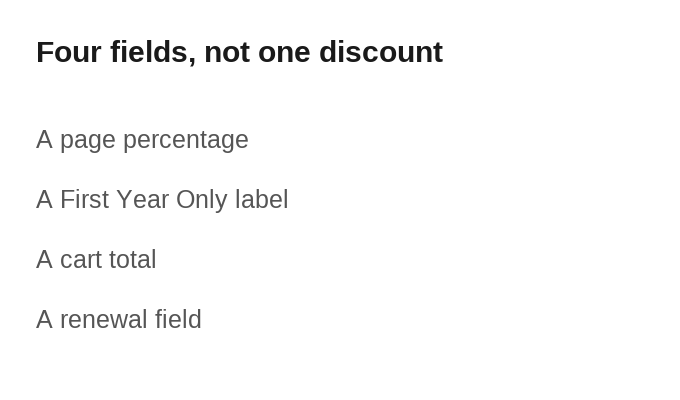
Four numbers that do different jobs
| Field | Where it appears | What it actually is | What I verified | Read date |
|---|---|---|---|---|
| Advertised percentage | Coupon-site headline | A claim attached to an offer | Printed figure, not a cart total | 2026-11-25 |
| First Year Only | Porkbun deals page | An official label on a sale price | Label read on the official page | 2026-11-21 |
| Cart total before and after | Checkout coupon box | What the cart charged before and after a code | $7.98 before, $6.98 after a working code | 2026-11-27 |
| Renewal field | Per-TLD page and cart | The price for a later year | $11.84 seen on the cart, separate fields on TLD pages | 2026-11-21 |
Percentages, sale labels, cart totals and renewal fields answer different questions. Reading one as another is how a headline turns into a wrong expectation at the payment screen.
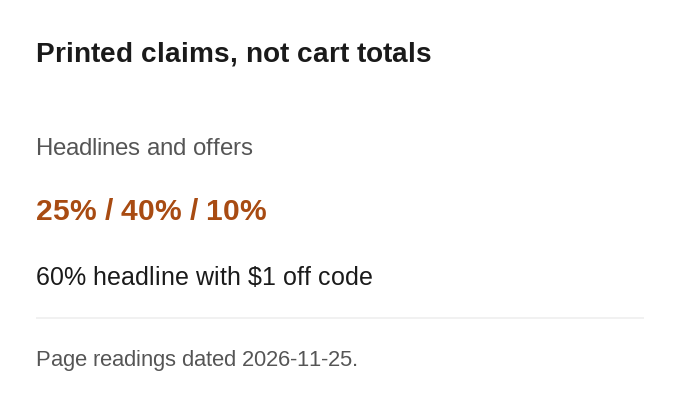
1. The advertised percentage is a printed claim
Three coupon pages carry percentages for this term. The readings below record the figure each page printed and what that figure was attached to; none of these figures came out of a cart I operated.
| Page | Figure printed | What the page attached it to | Reading date |
|---|---|---|---|
| CouponsKiss | 25% / 40% / 10% | A headline and an offer list; the offers also carried an expiry date | 2026-11-25 |
| RetailMeNot | 25% | An offer headline for cheap domains | 2026-11-25 |
| SimplyCodes | 60% | A page headline; the top code on that page was listed as $1 off | 2026-11-25 |
I did not carry any of those percentages into my own price table. A percentage beside an offer is a description written by the page; the amount that matters to a buyer is the total line after a code is submitted.
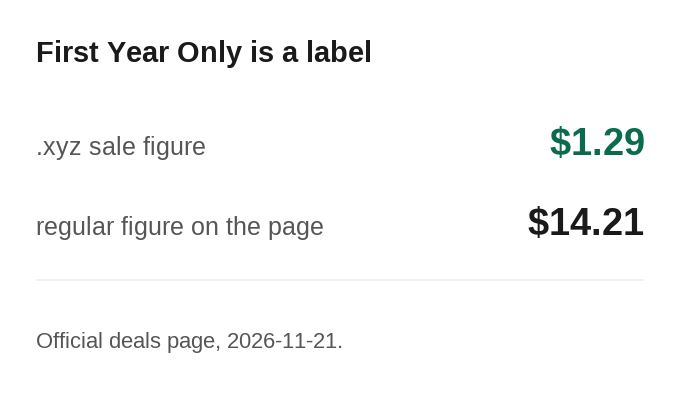
2. First Year Only is an official label, not a code
Porkbun's own deals page marks certain sale prices First Year Only. I read those labels and the paired regular prices on 2026-11-21:
| TLD | Sale price marked First Year Only | Regular price on the same page | Read date |
|---|---|---|---|
| .xyz | $1.29 | $14.21 | 2026-11-21 |
| .lol | $1.54 | $26.26 | 2026-11-21 |
| .cloud | $3.88 | $21.11 | 2026-11-21 |
| .inc | $257.98 | $2,060.25 | 2026-11-21 |
Those two columns are fields on a Porkbun page, not a before-and-after reading from my cart. The label limits which year the sale price belongs to. On the same 2026-11-21 reading, the deals page carried no box for entering a code; the box appears on the cart page.
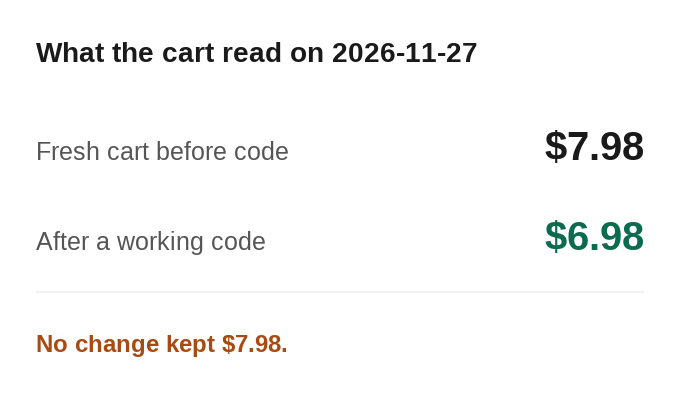
3. The landing point I measured today
For the landing point I used one live cart on 2026-11-27 and submitted each code in the checkout coupon box, starting from a clean cart each time. I stopped before the payment button throughout. A code counts as a cut only when the total I read after submission was lower than the total I read before it.
| Code | Cart before | Cart after | Verdict | Checked |
|---|---|---|---|---|
| GAMERTAG | $7.98 | $6.98 | Cut the line | 2026-11-27 |
| VIKAS | $7.98 | $6.98 | Cut the line | 2026-11-27 |
| EXODUS | $7.98 | $7.98 | No change | 2026-11-27 |
| GIMME10 | $7.98 | $7.98 | No change | 2026-11-27 |
| 50OFFBUNMAIL | $7.98 | $7.98 | No change | 2026-11-27 |
| C00L1FYLM40 | $7.98 | $7.98 | No change | 2026-11-27 |
All before-and-after figures in this article come from the same-day readings in this table. Nothing here is carried over from an earlier run, and no percentage was calculated from the two totals.
When the box refuses a code, Porkbun's own front end names the possible cases rather than quoting a rulebook: a code already applied, an expired code, a price too low, a premium domain, or a renewal where registration was expected. I read that wording in Porkbun's front-end file on 2026-11-26. It gives no amount and no end date; those belong to a code, not to a general page.
4. The renewal field is a separate number
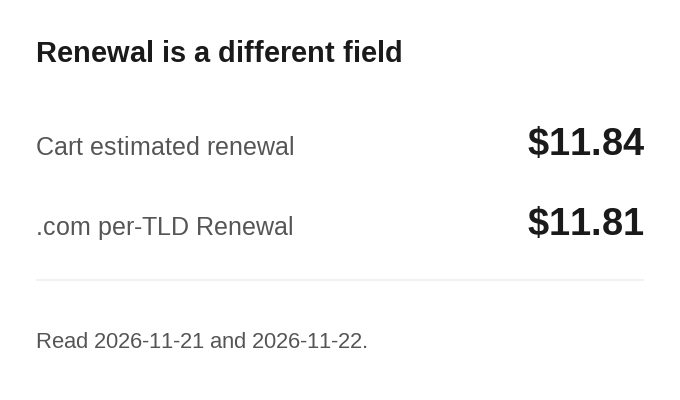
The cart screen showed an estimated renewal figure next to the first-year price on 2026-11-21. Per-TLD pages carry the same idea in their own Renewal field, read on the dates below.
| Where the figure was read | Renewal field | Read date |
|---|---|---|
| Cart estimated renewal line | $11.84 | 2026-11-21 |
| .org per-TLD page | $11.84 | 2026-11-22 |
| .com per-TLD page | $11.81 | 2026-11-22 |
| .xyz per-TLD page | $14.21 | 2026-11-22 |
| .lol per-TLD page | $26.26 | 2026-11-22 |
| .cloud per-TLD page | $21.11 | 2026-11-22 |
Today's cart run read the total line only. It did not measure a renewal, so I report no renewal result from 2026-11-27. Porkbun's FAQ, read on 2026-11-23, says first-year and renewal pricing are shown upfront and describes renewal pricing as having no surprise hikes; that is the page's wording, not a measurement from this run.
Reading a headline before you pay
1. Ask which field the number belongs to: a page claim, a first-year sale label, a cart total, or a renewal field.
2. Put the code in the cart box and read the total before and after submission.
3. Treat the renewal field as its own number; a first-year label does not rewrite it.
4. If the total did not move, the code did nothing for that cart, whatever the page claimed.
What I did not measure
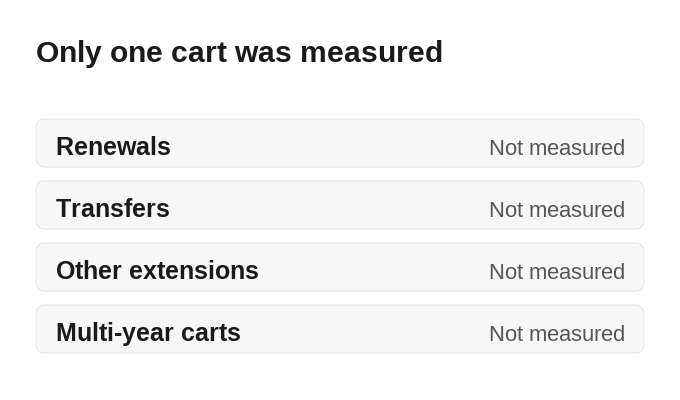
The run on 2026-11-27 covered one cart and the six codes listed above. It did not test renewals, transfers, other top-level domains, or multi-year carts, and I did not read any competitor figure into the price table.
Questions people ask before paying
If the page says 25% off, will my cart drop by that amount?
No. The percentage is a claim on a page, not a reading from your cart. In my run on 2026-11-27 the only drop I measured was from $7.98 to $6.98 after submitting a code.
Which codes changed the total when you tried them today?
GAMERTAG and VIKAS cut the line. The other four I entered left the total where it started. Every verdict came from the total line, not from a label on a coupon page.
Is First Year Only a code I can type into the box?
No. It is a label Porkbun puts on a sale price to say which year the price covers. The codes in the table above are separate strings submitted in the cart box.
Will the same reduction show up on my renewal?
I cannot say from today's run because I did not measure a renewal. The cart showed a renewal figure of $11.84 on an earlier reading, and per-TLD pages list their own Renewal fields, so it is a different number from the cart total.
Where do I type the code, and what tells me it worked?
The box is on the cart page, and I stopped before the payment button while testing. Compare the total before and after submission; if the line did not move, the code did nothing for that cart.
Do the expiry dates on coupon pages prove a code works?
No. An expiry date is information the page prints, not a result from a checkout. The only verdicts here are the ones I read from the total line on 2026-11-27.
Sources and method
- Before-and-after totals, code names and verdicts come from my own checkout run on 2026-11-27 at porkbun.com/checkout/cart, one code per clean cart in the #cartCouponCode box, stopped before payment.
- First Year Only sale prices and paired regular prices are readings of porkbun.com/products/deals on 2026-11-21. No percentage was calculated from them.
- Renewal figures are readings of the cart line on 2026-11-21 and of porkbun.com per-TLD pages on 2026-11-22.
- Page percentages are readings of three coupon sites recorded on 2026-11-25. None of those figures is used as a price here.
- The refusal wording and the FAQ wording come from Porkbun's own front-end file and FAQ page, read on 2026-11-26 and 2026-11-23.
- Prices, labels and page wording can change; these are readings of the stated dates, so re-read your cart on the day you buy.